
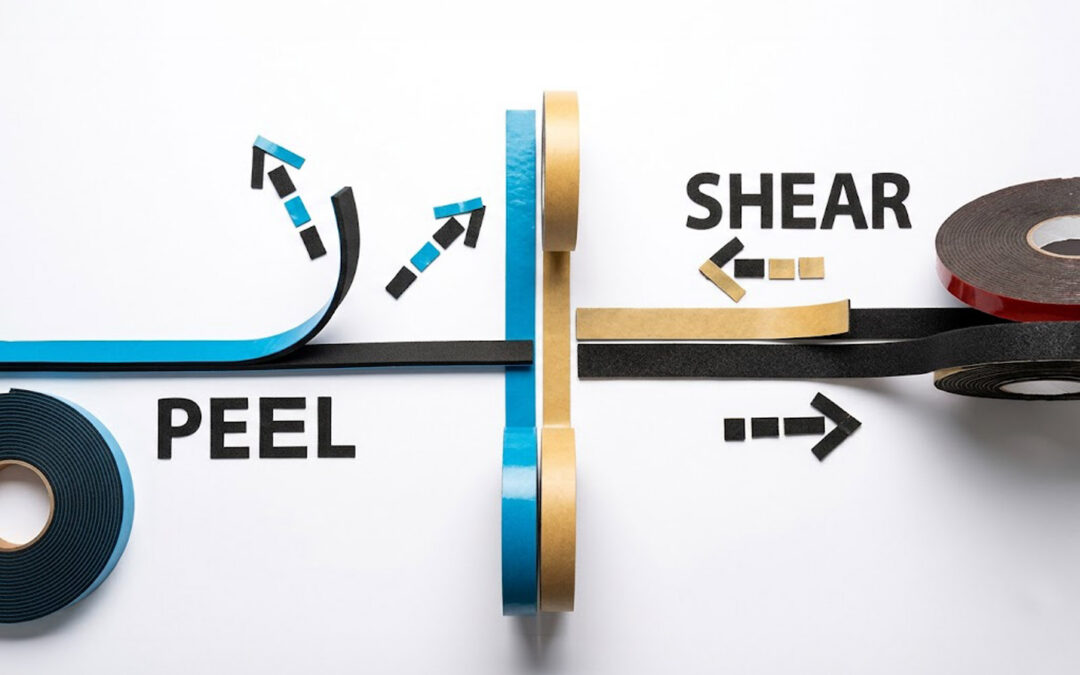
Understanding the battle between peel strength vs. shear strength is vital. Selecting a tape based on the wrong metric can result in catastrophic product failure.
Whether you are an engineer specifying tapes for curtain walls, a QA technician in a manufacturing plant, or a product manager comparing suppliers, choosing the right industrial tape is a precise science. If you look at a technical data sheet for an industrial-grade foam or acrylic tape, you will inevitably find two critical performance metrics listed side-by-side: Peel Adhesion and Shear Strength.
Let’s dive into what these properties mean, how they are tested, and how to balance them for your application.
What is Peel Strength? (The Edge Defender)
Peel strength (or peel adhesion) measures the force required to pull a tape away from a substrate at a specified angle and rate of speed. It evaluates the tape’s resistance to a pulling force applied perpendicularly or at an angle to the bond line.
- How it’s measured: Industry standards like ASTM D3330 typically measure peel adhesion by pulling a tape strip off a standard surface (usually stainless steel) at a 90-degree or 180-degree angle. Results are generally reported in ounces per inch (oz/in) or Newtons per 25 millimeters (N/25mm).
- Why it matters: Peel strength represents a tape’s immediate “grab” or initial tack, as well as its ability to resist lifting at the edges.
- Real-world failure mode: If a tape has low peel strength, its edges will curl, peel back, or lift away when exposed to wind, tension, or catching forces.
What is Shear Strength? (The Load Bearer)
Shear strength measures a tape’s ability to resist forces acting parallel to the bond line. Instead of trying to pull the tape off the surface, a shear force tries to slide the tape along the surface.
- How it’s measured: Following standards like PSTC-9 or ASTM D3654, a 1″ x 1″ sample of tape bonds two plates together. A static weight (often around 1 kg or 70.6 oz) is hung vertically from one plate. The test measures how many hours the tape can hold that weight without sliding off. High-performance tapes often boast “Over 100 hours” or “Over 10,000 minutes” of static shear resistance.
- Why it matters: Shear strength determines how well a tape handles continuous, heavy, structural loads over extended periods.
- Real-world failure mode: When a tape fails in shear, it results in “creep”—a slow, agonizing slide where the tape completely splits or slides down the wall, causing mounted signs, mirrors, or panels to drop.
Peel Strength vs. Shear Strength: The Ultimate Trade-off
The chemistry behind pressure-sensitive adhesives (PSAs) means that peel and shear strength often sit on opposite ends of a seesaw.
- High Adhesion + Low Shear: This adhesive grabs aggressively right out of the box. It will have an incredible initial tack and high peel numbers. However, under a constant vertical load, the adhesive will stretch and creep, causing the bond to slide and eventually fail over time.
- High Shear + Moderate Peel: This tape might not feel intensely sticky to the touch right away. However, once applied and allowed to cure (dwell time), it forms an incredibly rigid internal structure capable of hanging heavy components indefinitely.
As a rule of thumb, “higher is not universally better” when looking at peel numbers. An excessively high peel adhesive applied to a delicate surface can rip paint or film right off the substrate during an accidental shift.
Real-World Applications: Which Metric Matters Most?
How do you know which property to prioritize when analyzing peel strength vs. shear strength? It all comes down to how forces will act on your final assembly.
1. Architectural Glazing and Curtain Walls
When bonding glass panels to metal frames, the primary force acting on the tape is the weight of the glass pulling straight down parallel to the frame. For these applications, high static shear strength is non-negotiable. Tapes like the Capital Tape 5200 Residential Glazing Series or the 4400 Ultra-High Bond Series are engineered specifically with exceptional shear and tensile strength to support permanent vertical loads.
2. Automotive Side Moldings and Emblems
Automotive parts experience a mix of forces. When a car drives at highway speeds, wind tries to get under the edge of an emblem and peel it off (requiring high peel strength). Simultaneously, gravity and vibration try to slide it down the car door (requiring high shear strength). For this balanced environment, solutions like the 9230EZ Performance Mounting Tape utilize a solvent-based acrylic adhesive to provide both robust peel adhesion and superior heat/shear resistance.
3. Indoor Mounting and Signage
When mounting lightweight mirror tiles, labels, or indoor signage, initial tack and holding power are equally valuable. Specialized polyethylene closed-cell foam tapes (such as Capital Tape 9223 or 9226) feature a rubber-based adhesive that offers a high initial peel tack to grab the wall instantly, backed by over 100 hours of shear strength to ensure the sign stays put.
Peel Strength vs. Shear Strength Conclusion: Don’t Guess, Test
When comparing industrial tapes, looking at a single number on a spec sheet won’t give you the full picture. A tape that feels incredibly sticky to your thumb might fail on a vertical wall within a week if its shear strength isn’t up to par.
Before specifying your next tape solution, analyze the direction of the load, the environmental factors (like heat, which weakens shear strength), and the texture of your substrates. Working alongside a converting expert can help you evaluate your specific application variables and run the necessary sample tests to ensure a permanent bond.
If you’re looking for specific tapes cut to standard or non-standard sizes and shipped exactly where you need them, contact Capital Tape! Call: 1-888-888-TAPE during business hours or you can get a quote online 24/7 here!
Looking for more support? Check out these helpful links:
DATA SHEETS | ARTICLES | FREQUENTLY ASKED QUESTIONS | TROUBLESHOOTING
Follow Capital Tape on LinkedIn